 Care
Dental Claim Narratives: AI Agent vs Service vs Staff
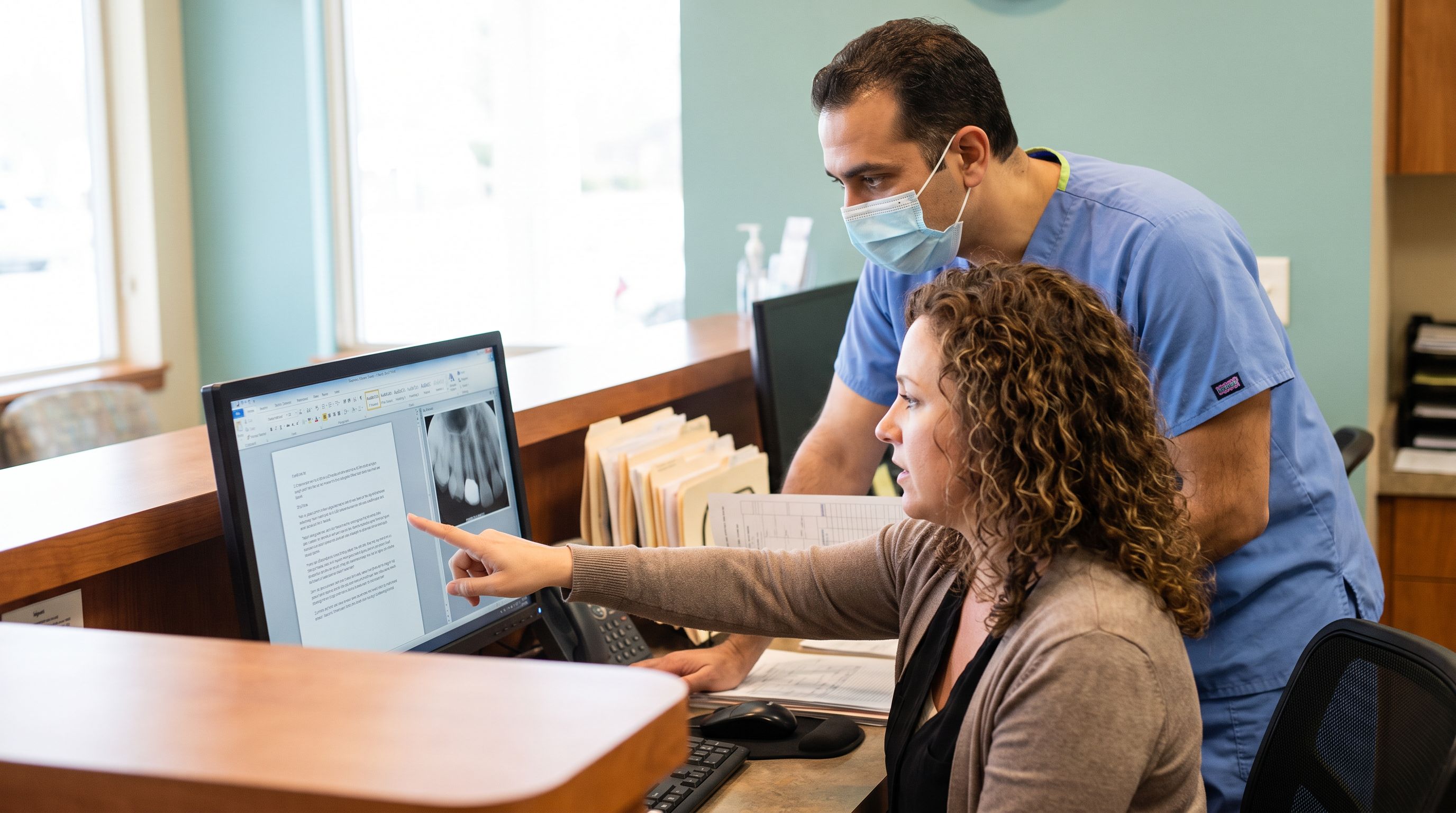
The workflow nobody documents
Every practice has a quiet bottleneck between “treatment completed” and “claim submitted.” Someone has to decide which codes need supporting documentation, find the right radiographs and perio chart, and write a paragraph that translates clinical reality into the language a payer’s reviewer expects. For scaling and root planing, that means whatever your dentist and your payers treat as the supporting picture. For a crown, it means the reason the tooth can’t be restored with a direct restoration. For a surgical extraction, it means what made it surgical.
The information almost always exists in the chart. The work is retrieval, judgment, and phrasing — repeated dozens of times a week by whoever has time. That is exactly the shape of work AI agents handle well, and exactly the shape of work where a fabricated sentence creates real exposure.
Four realistic paths to a written narrative
Staff with templates. The default. A biller or office manager keeps a document of narrative templates per code and fills in the blanks. Cheap, fully controlled, and completely dependent on who’s at the desk that day. Quality drifts when the person who wrote the templates leaves.
An attachment service or clearinghouse module. Dental attachment tools (the category includes offerings from Vyne, DentalXChange, and modules inside major practice-management systems — verify current capabilities with each vendor, as these change) are strong at the transport problem: attaching images to the right claim, meeting payer-specific attachment requirements, and tracking what was sent. They are generally not writing a reasoned narrative from your perio chart. The regulatory picture here is unsettled: HHS has proposed standards for health care attachments transactions, and as of 2026 that work remains proposed rather than final — check the Federal Register for current status rather than assuming your workflow is about to be standardized.
An AI narrative feature inside the software you already pay for. Practice-management and RCM platforms are shipping their own AI drafting and documentation-check features, often bundled or cheaply add-on priced. Capabilities vary widely and change quarterly, so test rather than trust the datasheet — but if your vendor offers one, it is usually the cheapest possible test of whether AI-drafted narratives help your practice at all. Find that out before anyone scopes a build.
An AI agent with chart access and a packaged skill. The newer option: an assistant like Claude connected to practice-management data, running a reusable skill — a packaged set of instructions that produces the same narrative structure every time — then handing a draft to a human for review and the dentist for attestation.
For most practices the honest answer is both — the service moves the documents, something else writes the words — or neither yet, if your charting is inconsistent enough that no system could draft from it.
What the agentic version actually looks like
The plumbing matters more than the prompt. Giving an AI assistant governed access to practice data is what MCP (the Model Context Protocol, an open standard for connecting assistants to tools and data) is for; we walk through the mechanics in more depth in our guide to connecting Claude to an EHR via MCP.
-
Expose only the fields the job needs
Build or configure an MCP server over your practice-management system that returns, for one appointment: completed codes, perio chart entries, radiograph metadata and image references, clinical note text, and prior treatment history. Nothing else. Minimum-necessary access is a HIPAA principle, and it’s also what keeps the agent focused. -
Write the skill, one code family at a time
Start with your highest-volume documentation-sensitive code — SRP is the usual candidate. The skill specifies the required inputs your treating dentist identifies as necessary to support that code, the output structure, the tone, and an explicit instruction: if a required field is absent from the chart, say so and stop. The clinical criteria are the dentist’s call, not the vendor’s and not the article’s; verify code descriptors against current ADA CDT guidance, which is updated annually. -
Make 'missing documentation' a first-class output
The most valuable thing the agent produces on day one isn’t prose — it’s a list of visits where the chart can’t support the code yet. That’s a coaching signal for the clinical team, before the claim goes out. -
Route to human review, then provider attestation
Draft lands in a queue. The biller checks it against the chart. The dentist attests. Nothing auto-submits. Log every draft, edit, and approval. -
Close the loop on denials
Feed denial reasons back so you can see which narratives actually hold up with which payers. This pairs naturally with AI-assisted denial triage.
The agent’s job is to retell what the chart says, faster and more consistently. The moment it starts filling gaps, you’ve built a liability instead of a tool.
Choosing a tool for this specific job
People searching for the best AI for medical or dental professionals usually get pointed at clinical reference and triage tools — OpenEvidence, Glass Health, Hippocratic AI — which solve different problems entirely (we compare that category in our rundown of medical AI tools). For narrative drafting, the relevant criteria are narrower: will the vendor sign a BAA, can it reach your practice-management data, can you version the instructions, and does it keep an audit trail?
Set expectations honestly before you buy anything: a well-written narrative does not guarantee payment. Payer policy, frequency limitations, waiting periods, and plan exclusions drive a large share of denials that no amount of prose can fix, so discount any denial-recovery figure you model accordingly.
Free consumer chat tools fail the BAA test for anything involving PHI. A de-identified template exercise is a legitimate free use — drafting ten SRP narrative skeletons with no patient data in them costs nothing and improves your templates today. That’s a reasonable starting point if a build isn’t on the table.
About the “30% rule” that circulates in AI discussions: there is no authoritative standard behind it, and anyone citing it as a benchmark is improvising. The useful version of the idea is just scoping — pick the slice of a workflow the agent can do reliably, keep the rest human, and expand only when measured results justify it.
Who owns it after launch
The jobs that shrink here are typing jobs, not judgment jobs. Reading a perio chart and deciding whether documentation supports the code is clinical and billing judgment; knowing which payer wants a pre-op radiograph is institutional knowledge. In our view, practices that get value from this reassign recovered front-desk time toward work that moves money — unscheduled treatment follow-up, insurance verification quality, and patient financial conversations.
But be realistic: a custom agent needs a named owner who updates the skill when CDT codes change, a payer shifts requirements, or your PM system updates its API. In a two-operatory practice there may be no one who can absorb that, and a build whose owner leaves fails exactly the way the template document fails when its author leaves — quietly, and only discovered in the denial report. If you can’t name the owner and a backup, buy the feature instead.
Model the payoff with your own numbers
Don’t accept anyone’s ROI chart, including ours. Build it from four inputs you can measure in a week.
Worked example, with every number an assumption you should replace: assume 40 narratives a week at assumed 6 minutes each. That’s 4 hours a week, roughly 17 hours a month. Assume the agent cuts drafting time by half — review and attestation don’t go away — leaving about 8 recovered hours a month. Multiply by your own loaded hourly rate; we’re not going to invent one. Then add whatever share of your documentation-related denials you genuinely believe better narratives would have prevented, after discounting for the policy-driven denials above. Compare that monthly figure against a real quote plus maintenance time.
If the recovered hours are small and your denial rate on these codes is already low, disciplined templates and a good attachment service will beat a build. If you’re submitting high volumes of documentation-sensitive codes across several payers with inconsistent narrative quality, the composition step is where custom work earns its keep. Before anything touches a real chart, settle two specifics in writing: the scope of your BAA with any vendor processing PHI, and how long you retain the audit log of drafts, edits, and attestations.
Not sure where to start?
Get a free automation audit: we map your scheduling, intake, insurance, billing, and patient communication and show you what's worth automating — before you spend a dollar.
Get a free automation auditRelated guides

AI Patient Booking Agents: Directory vs Site vs MCP
Patients are starting to book care through AI agents. Compare directory APIs, your own site, and a custom MCP endpoint — with HIPAA guardrails and a cost model.
Read guide →
Outcome Measures: AI Agent vs MBC Platform vs Manual
A vendor-neutral guide to measurement-based care automation: AI agents vs MBC platforms vs manual PHQ-9/GAD-7 workflows, with HIPAA and escalation guardrails.
Read guide →
No-Show Prediction: EHR Analytics vs AI Agent vs Overbook
No-show prediction compared three ways: built-in EHR analytics, a custom AI agent over your PM data, and plain overbooking — with HIPAA and fairness guardrails.
Read guide →